
The 20% of Invoices That Steal 80% of Your Time
Most invoices follow a clean path. But around 20% — the edge cases — consume the majority of processing time. Learn why and how to handle them.


Invoice processing looks simple on paper.
Clean flow. Predictable, that's the theory.
In practice, most invoices do follow this path. But a smaller portion — often around 20% — requires disproportionate effort and attention.
These are the edge cases.
When the Invoice Reflects Business Reality, Not System Logic
Edge cases are not necessarily errors. They arise when invoices reflect how business actually operates rather than how systems are structured. Typical examples include:
- An invoice linked to an older Rahmenvertrag (framework contract) with terms that evolved over time
- Price deviations from the original Bestellung (purchase order) due to negotiated adjustments
- Partial deliveries split across multiple shipments
- Credit notes referencing earlier transactions that require historical context
- Service invoices without a direct system reference but tied to ongoing projects
Maverick Buying
A particularly common and complex scenario is:
Here, goods or services are procured outside the formal purchasing process:
- No purchase order was created
- No prior system entry exists
- Approval may have happened informally
The transaction itself can be legitimate, yet finance must clarify:
- Who authorized the expense
- Which department or project owns the cost
- Whether an existing contract should have been used
- How the case aligns with internal policy
At this point, the task moves beyond document processing into organizational clarification.
Why These Cases Consume Disproportionate Time
Standard invoices follow structured references. Edge cases do not. Handling them requires connecting information across multiple sources:
- Contracts and amendments
- Purchase orders and order history
- Delivery documents
- Email approvals and project communication
- Internal rules and exceptions
Processing therefore involves reconstructing the business context behind the document. This is why a minority of invoices can consume the majority of processing time.
Why Rule-Based Automation Struggles
Traditional automation models are designed for predictable logic:
Edge cases fall outside this pattern because:
- Key references may be missing or indirect
- Deviations may be contractually correct
- Multiple documents and historical transactions must be interpreted together
The challenge is less about reading the invoice and more about understanding the business situation it represents.
How Flowbit AI Approaches This Differently
Instead of treating invoices as isolated documents, Flowbit AI connects them to their business context.
The system links invoice data with:
- Contracts and framework agreements
- Orders and historical purchasing patterns
- Related delivery and transaction records
- Communication trails where relevant
This allows deviations to be assessed within context rather than flagged blindly as errors. Maverick buying cases, for example, can be analyzed against past supplier relationships, similar transactions, and policy patterns — reducing the need for repeated manual investigation.
The result is not only faster processing of standard cases, but structured handling of the complex ones that typically consume the most time.
Related reading

Where Posting Logic Actually Lives (Before Invoices Reach DATEV)
Discover where posting logic actually resides before invoices reach DATEV. Understanding the decision complexity that drives finance workload.
Read article →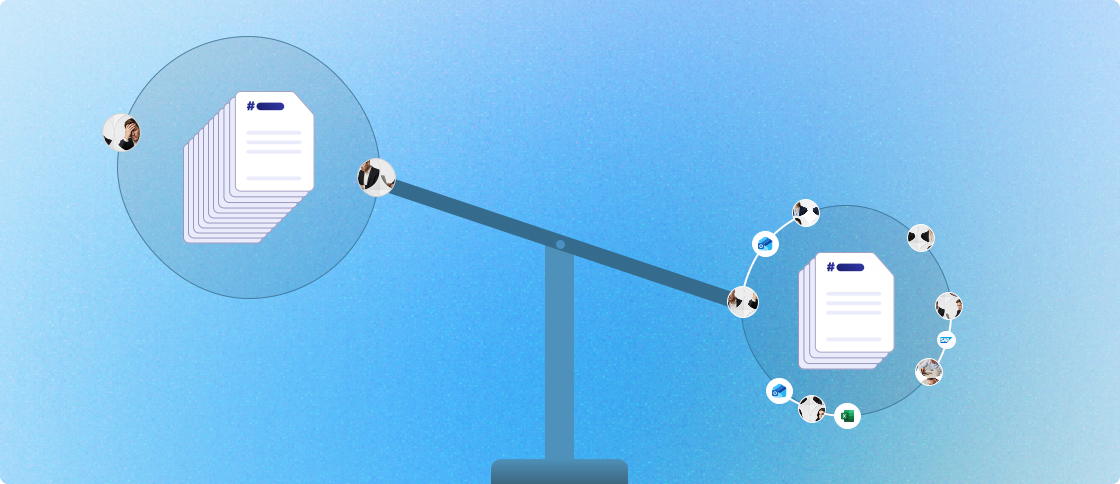
The 4 Invoice Metrics That Actually Show Finance Workload
Most finance teams track invoice volume. Learn the 4 metrics that actually show finance workload and decision complexity.
Read article →
Why OCR Alone Is Not Enough for Financial Document Processing
OCR reads documents and converts them into text. But it doesn't understand context, validate meaning, or connect data to business processes. Learn what comes after extraction.
Read article →